
Key Takeaways
Bangkok’s BTS Skytrain and MRT subway are essential for navigating the city, with the BTS offering elevated routes primarily along Sukhumvit and Silom, and the MRT providing underground access to areas like Chinatown and Chatuchak. Both systems connect at key interchanges, making it possible to reach most major destinations efficiently.
- The BTS Skytrain operates on two main lines: the Sukhumvit line and the Silom line.
- Siam station is a crucial interchange where the BTS Sukhumvit and Silom lines cross.
- The MRT Blue Line provides access to areas such as Sukhumvit, Silom, Chinatown (Wat Mangkon), and Hua Lamphong.
- Key interchanges like Asok (BTS) and Sukhumvit (MRT), and Mo Chit (BTS) and Chatuchak Park (MRT) facilitate transfers between the systems.
- StayAt Bedever is conveniently located just 15 steps from the BTS Phra Khanong exit, offering excellent access to the BTS network.
Understanding Bangkok’s Rail Network
Bangkok’s urban landscape is vast, and its traffic can be challenging. Fortunately, the city boasts an efficient public rail system, primarily composed of the BTS Skytrain and the MRT subway. These two networks form the backbone of urban transit, allowing both residents and visitors to bypass road congestion and travel quickly across the city. Understanding how they differ and connect is key to maximizing your time in Bangkok.
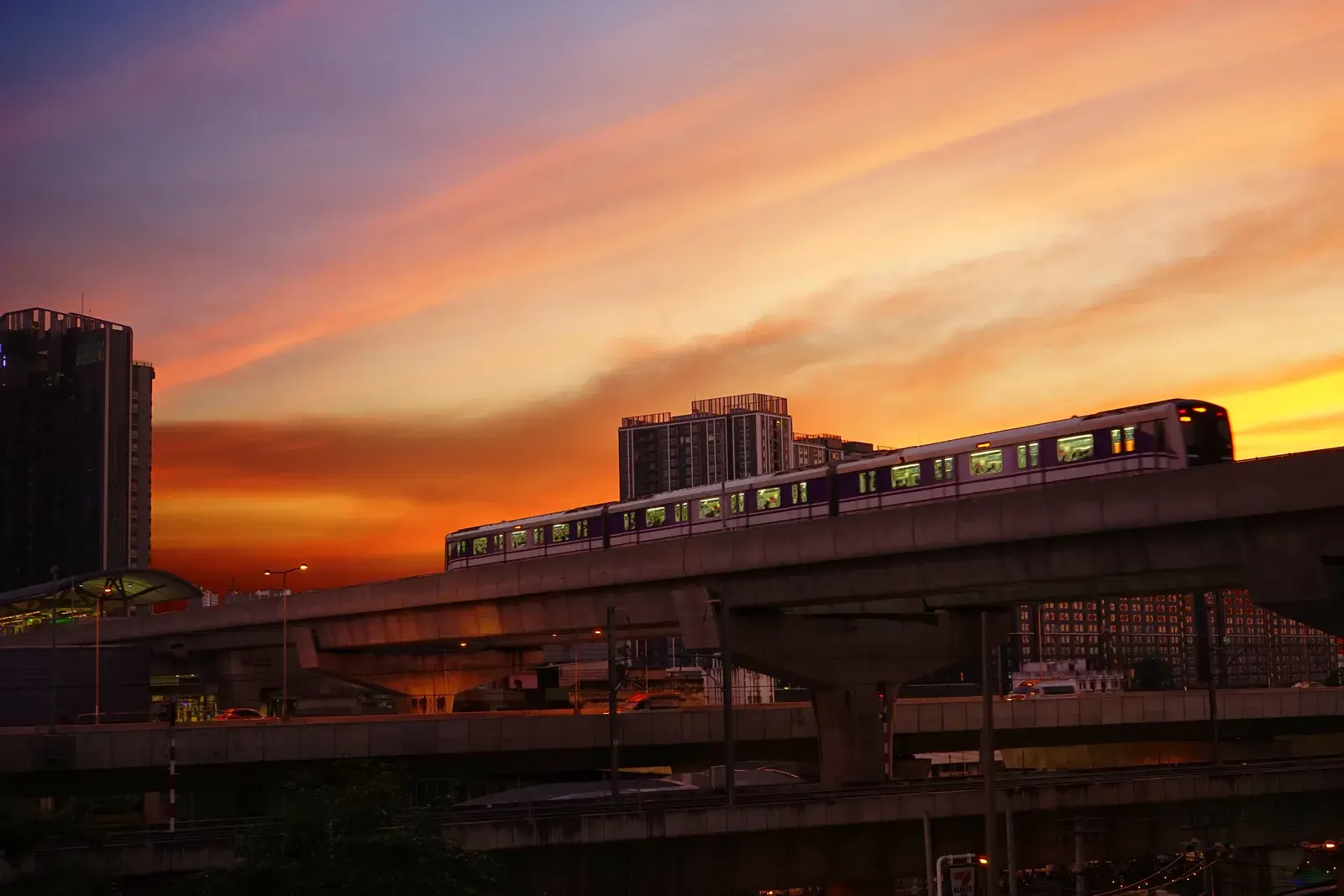
The BTS, or Skytrain, is an elevated rail system that offers panoramic views of the city as you travel. It’s particularly well-suited for reaching many of Bangkok’s modern shopping districts, entertainment hubs, and business areas along its two main lines. The MRT, an underground subway system, complements the BTS by serving different parts of the city, including cultural sites and major markets that the Skytrain does not directly cover.
BTS Skytrain: Elevated Convenience
The BTS Skytrain is a prominent feature of Bangkok’s skyline, with its trains running on elevated tracks. It consists of two primary lines: the Sukhumvit line and the Silom line. These lines intersect at Siam station, a central hub for transfers and a major shopping destination itself. The Sukhumvit line extends through popular areas such as Nana (E3), Asok (E4), Phrom Phong (E5), Thong Lo (E6), Ekkamai (E7), Phra Khanong (E8), and On Nut (E9) in its eastern branch. It also serves northern areas like Phaya Thai (N2), Victory Monument (N3), Ari (N5), and Mo Chit (N8).
For travelers staying at StayAt Bedever, the BTS Phra Khanong station is incredibly convenient, located just 15 steps from the hotel exit. This direct access makes exploring the city via the Skytrain exceptionally easy. From Phra Khanong, you can quickly reach various points along the Sukhumvit line, or transfer at Siam to the Silom line to explore other parts of the city.
MRT Subway: Underground Connections
The MRT, or Metropolitan Rapid Transit, operates primarily underground, providing access to areas not directly served by the BTS. The MRT Blue Line is particularly useful, connecting key districts such as Sukhumvit, Silom, Chinatown (Wat Mangkon), and Hua Lamphong. This makes it an excellent choice for reaching cultural landmarks and historical neighborhoods. For instance, to visit the Grand Palace in the Rattanakosin old town, you would typically use the BTS to Saphan Taksin on the Silom line, then transfer to a Chao Phraya river boat. However, the MRT offers alternative routes to other cultural sites like Chinatown.
Interchanges between the BTS and MRT are strategically placed to ensure seamless travel. For example, BTS Asok (E4) connects directly to MRT Sukhumvit station on the MRT Blue Line. Similarly, BTS Mo Chit (N8) provides a connection to MRT Chatuchak Park, which is ideal for visiting the Chatuchak Weekend Market on Saturdays and Sundays.
| Feature | BTS Skytrain | MRT Subway |
|---|---|---|
| Type of System | Elevated Rail | Underground Rail |
| Key Lines | Sukhumvit, Silom | Blue Line |
| Central Interchange | Siam (between BTS lines) | Sukhumvit, Chatuchak Park (with BTS) |
| Coverage Examples | Sukhumvit Road, Silom Road | Chinatown, Hua Lamphong |
| Airport Connections | Airport Rail Link at Phaya Thai | None direct to airports |
Choosing Your Rail System
Deciding which rail system to use often depends on your destination. For destinations along Sukhumvit Road or Silom Road, the BTS is usually the most direct option. Its elevated nature also provides a different perspective of the city. For areas like Chinatown, the MRT is the primary choice. Many popular attractions and neighborhoods are accessible via a combination of both systems, often involving a quick transfer at one of the designated interchange stations.
For arrivals and departures, the Airport Rail Link from Suvarnabhumi Airport connects to the BTS at Phaya Thai. If you are arriving from Don Mueang Airport, you can use the A1 bus to Mo Chit, which then connects to the BTS, or take the SRT Dark Red Line to Krung Thep Aphiwat.
Plan your stay
StayAt Bedever is a boutique hotel about 15 steps from BTS Phra Khanong, run by a Singaporean hospitality team. It is built for exactly the trip this guide describes: a clean, comfortable, well connected base with our own Born to Bean cafe downstairs and a proper 5-Star Sleep setup upstairs.
Book direct and you deal with the people who actually run the hotel, not a booking platform, and our direct guests get a little extra every stay.
Book StayAt Bedever direct, or just chat with us on WhatsApp or LINE.
Key Questions Answered
What are the main differences between BTS and MRT in Bangkok? The BTS Skytrain is an elevated rail system with two lines (Sukhumvit and Silom) that cross at Siam station, while the MRT is an underground subway system, with its Blue Line serving areas like Sukhumvit, Silom, Chinatown, and Hua Lamphong.
How do I get to Chatuchak Weekend Market using public transport? To reach Chatuchak Weekend Market, you can take the BTS to Mo Chit station, which connects to MRT Chatuchak Park, or take the MRT directly to Chatuchak Park.
Can I transfer between BTS and MRT easily? Yes, there are several convenient interchange stations, such as BTS Asok (E4) connecting to MRT Sukhumvit station, and BTS Mo Chit (N8) connecting to MRT Chatuchak Park.
Which rail system is better for reaching the Grand Palace? For the Grand Palace, the classic route from the Sukhumvit line involves transferring at Siam (CEN) to the Silom line, alighting at Saphan Taksin, and then taking a Chao Phraya river boat.
How can I get to StayAt Bedever using Bangkok’s rail systems? StayAt Bedever is conveniently located just 15 steps from the BTS Phra Khanong exit, providing direct and easy access to the BTS Skytrain network.
Sources
Structure and Stations : Routes Area Map Chatuchak Market Songkran: The world’s biggest water fight